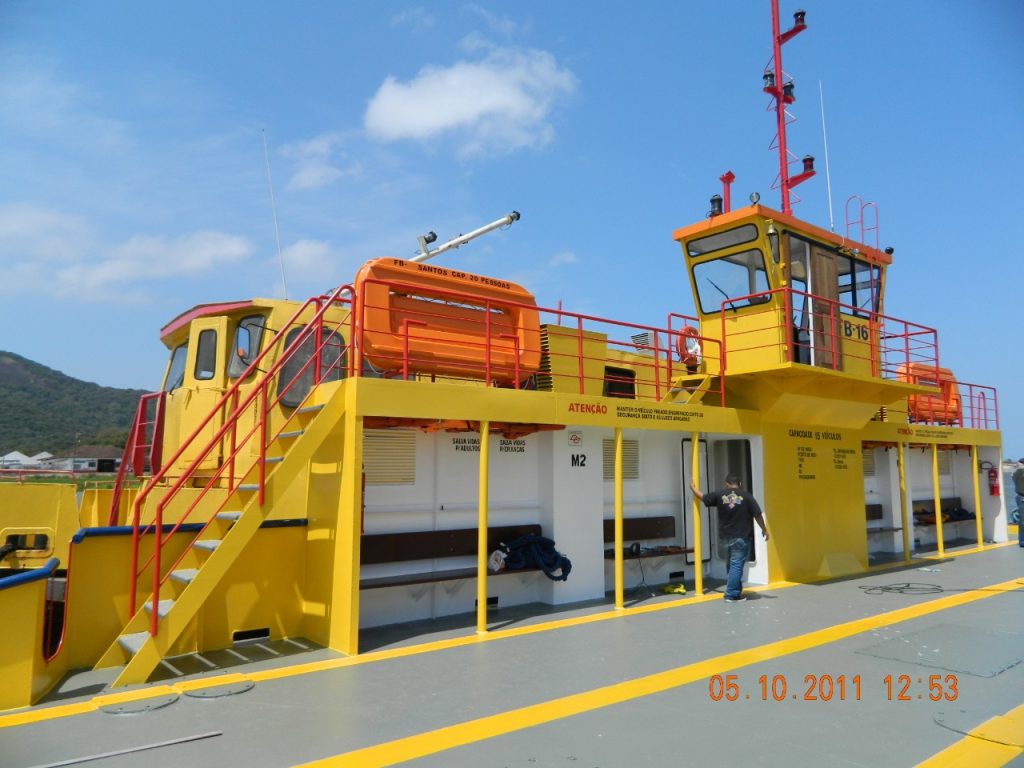
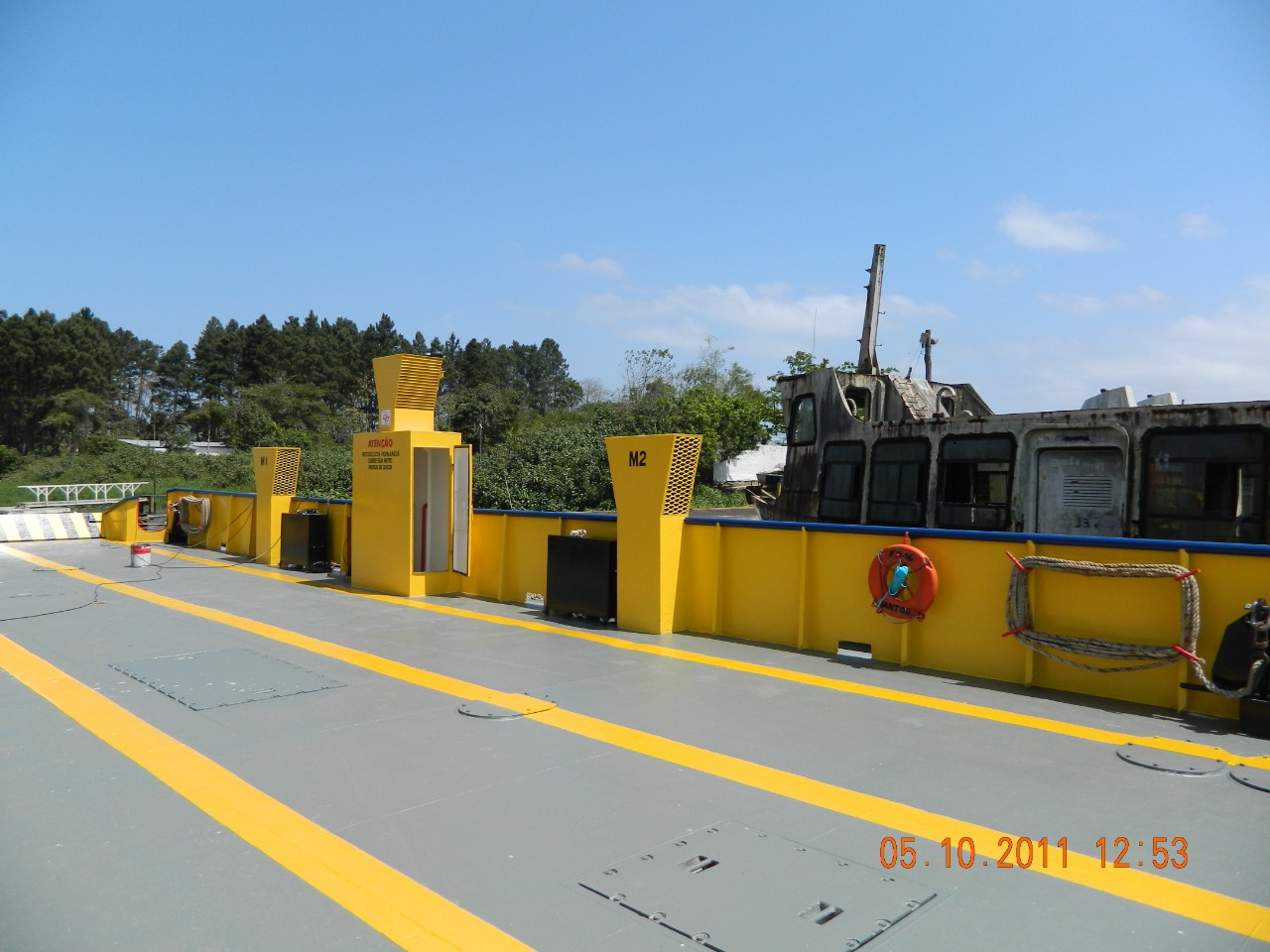
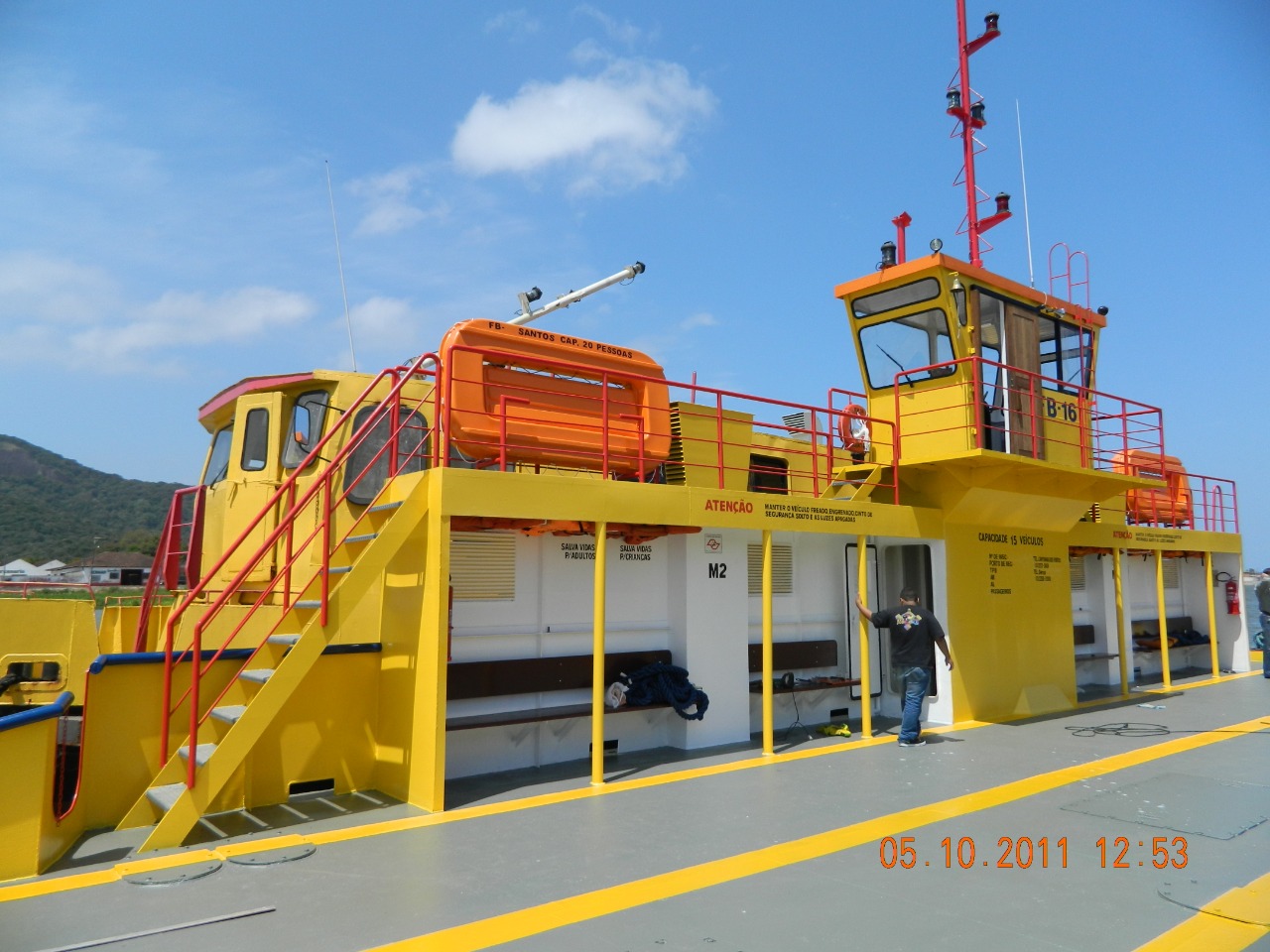
The Engport Group was hired by DERSA to carry out the complete structural refurbishment of Ferry FB-16, one of the most important vessels in the Coastal Crossings System of the State of São Paulo. This ferry operates on the strategic Cananéia/Ilha Comprida Crossing in the South Coast, transporting thousands of vehicles and tourists monthly.
THE COASTAL CROSSINGS SYSTEM
Since 1989, DERSA has been managing the Coastal Crossings System of the State of São Paulo, consisting of eight critical crossings connecting islands and the mainland along the entire coast of São Paulo. The FB-16 is a ferryboat with the capacity to transport approximately 20-25 vehicles per trip, operating 24 hours a day, 7 days a week.
The Cananéia/Ilha Comprida Crossing is particularly critical: the only direct connection between the mainland and Ilha Comprida, a tourist region with 110 kilometers of preserved coastline, beaches, and UNESCO-listed Atlantic Forest. During the high season (December to March), the traffic reaches over 1,000 vehicles per day.
THE CRITICAL CONTEXT
In 2011, after years of uninterrupted operation exposed to the extremely aggressive marine environment of the Cananéia Channel (brackish water, constant salt spray, tidal cycles), the FB-16 showed severe structural compromise:
- Hull plating with advanced corrosion (perforations and thinning)
- Oxidized internal structures
- Imminent risk of closure by the Port Captaincy
- Urgent need for refurbishment before the summer high season
DERSA made the strategic decision: complete and emergency refurbishment of the vessel to return it to operation as quickly as possible, minimizing the impact on the crossing.
THE CHALLENGE: MARITIME ENVIRONMENT WORK
Refurbishing a large vessel in Iguape, near the Cananéia Channel, presented unique challenges:
- Remote location: Over 200 km from São Paulo, complex logistics
- Aggressive environment: Outdoor work, salt spray, frequent rains
- Tight deadline: 6 months for complete refurbishment
- High visibility work: Ferry out of operation impacting thousands of users daily
- Public pressure: Local press coverage, residents demanding return
EXECUTION METHODOLOGY
Our team developed a detailed plan to maximize efficiency:
PHASE 1 – DIAGNOSIS AND PREPARATION (1 MONTH):
- Complete inspection of the hull and superstructure
- Mapping of all compromised areas
- Specification of materials (plates, profiles, consumables)
- Logistics for transporting heavy materials to Iguape
- Mobilization of team and equipment
PHASE 2 – REMOVAL OF COMPROMISED PLATING (1 MONTH):
Team of 20 professionals working simultaneously:
- Oxy-fuel cutting of all oxidized plating
- Removal of compromised internal structures
- Complete cleaning of affected areas
- Surface preparation for new plates
Special challenge: Hot cutting in a maritime environment with high humidity and constant natural ventilation. Need for wind protection to ensure quality cuts.
PHASE 3 – MANUFACTURING AND INSTALLATION OF NEW PLATING (4 MONTHS):
The most complex and labor-intensive phase:
Manufacturing:
- Cutting naval steel plates ASTM A36 with exact dimensions
- Forming (rolling when necessary)
- Preparation of bevels for welding
- Pre-assembly on land
Installation:
- Hoisting and positioning of large plates (up to 500 kg each)
- Structural welding with coated electrode E7018
- Fillet and butt welds as per naval project
- 100% visual inspection of welds
- Non-destructive testing on critical welds (penetrant liquid)
Welding Team:
- Qualified welders in naval welding
- SMAW processes (shielded metal arc welding)
- Inspection by certified level 2 professional
PHASE 4 – COMPLETE PAINTING OF THE VESSEL (1 MONTH):
Anticorrosive painting system for a marine environment:
Surface preparation:
- Mechanical sanding of all metal surfaces
- Removal of mill scale
- Cleaning with solvent
- Complete drying
Paint application:
- Anticorrosive epoxy primer (2 coats)
- Intermediate epoxy paint (2 coats)
- Finish with synthetic nautical enamel (2 coats)
- Total system: 6 coats, controlled DFT (thickness)
Colors:
- Hull: DERSA Standard (yellow and white)
- Safety markings as per Navy regulations
- Applied FB-16 numbering
TIME PRESSURE
Like all critical public infrastructure projects, the pressure was constant:
- Users: Thousands of residents and tourists depended on the crossing
- Press: Local newspaper reporting weekly progress
- DERSA: Internal demand for return to operation
- Government: Project monitored by state representatives
Additionally, the region’s unstable weather (frequent rains, strong winds) delayed welding and painting work, requiring constant replanning.
HSE MANAGEMENT IN NAVAL ENVIRONMENT
Work on vessels requires special attention to safety:
- Work at height (upper deck, 4-5 meters)
- Confined spaces (inside the hull)
- Hot work (welding and cutting) with fire risk control
- Specific personal protective equipment (flame-retardant uniforms)
- Training NR-34 (Hot Work) and NR-33 (Confined Space)
- Emergency and rescue plan
EARLY DELIVERY
OCTOBER 5, 2011 – 5 days AHEAD of schedule:
 Entire metal structure recovered New plating installed Complete painting finished Buoyancy and stability tests approved Port Captaincy certification renewed Vessel returned to operation immediately
ACHIEVED RESULTS
Early completion: 6 months turned into 5 months and 16 days Zero accidents: In complex naval environment works Certified quality: Port Captaincy approval without reservations Positive social impact: Ferry resumed operation before November (start of high season) Public recognition: Government and DERSA highlighted efficiency
QUANTITATIVE DATA
- Plating replaced: 20+ tons of naval steel
- Team (peak): 20 simultaneous professionals
- Duration: 6 months (completed in 5.8 months)
- Welds executed: 300+ linear meters
- Painted area: 800+ m² (entire hull)
- Work hours: 14,400 man-hours
- Rework rate: <2%
- Accidents: 0
- Ferry capacity: 20-25 vehicles/trip
- Location: Cananéia Channel (South Coast SP)
LASTING IMPACT
The refurbishment of the FB-16 allowed the vessel to return to operation and continue serving for many subsequent years, transporting thousands of vehicles and hundreds of thousands of people between Cananéia and Ilha Comprida.
This project consolidated our experience in the naval segment and demonstrated our ability to execute complex works in remote locations, under deadline pressure and with high public visibility – characteristics that would become a trademark of the Engport Group in the following years.
The FB-16 became part of the DERSA Coastal Ferry Modernization Program initiated in 2011, operating in conjunction with the FB-12 on the Cananéia/Ilha Comprida ferry route, which transports more than 8,000 vehicles per day during peak season.